
Choosing a mattress when comfort, posture and back support are priorities can feel overwhelming. You may come across terms such as “orthopaedic mattress”, “spinal support”, “zoned support” and “pressure-relieving mattress”, along with a wide range of materials, firmness levels and price points.
So, what should you actually look for?
At Chiro Care Mattresses, we specialise in orthopaedic mattresses designed to provide supportive, comfortable sleep. Understanding the different mattress constructions available can help you choose an option that better suits your sleeping position, comfort preferences and support needs.
This guide explores the main types of orthopaedic mattresses available in Australia, including innerspring, memory foam, latex, hybrid and zoned-support mattresses.
What Is an Orthopaedic Mattress?
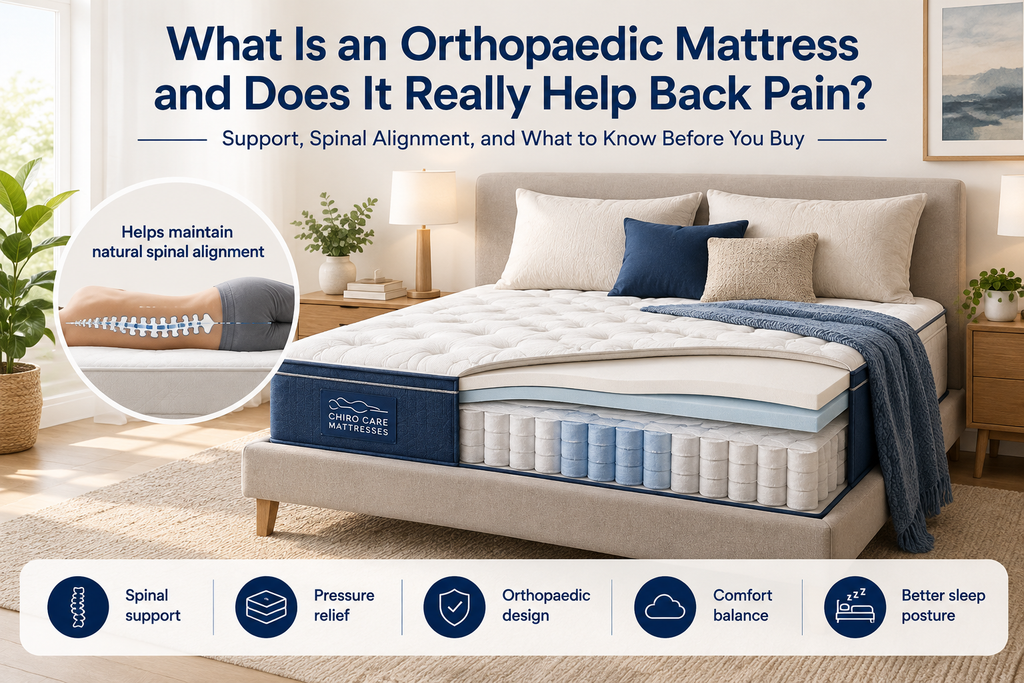
An orthopaedic mattress is designed with an emphasis on body support, pressure distribution and spinal alignment during sleep.
Unlike a standard mattress that may focus primarily on softness or general comfort, an orthopaedic mattress typically incorporates supportive materials or construction techniques intended to help prevent excessive sinking and provide more consistent support across the body.
Common features can include:
- Supportive spring or foam systems
- Medium-firm to firm comfort levels
- Zoned support through different areas of the mattress
- Pressure-relieving comfort layers
- Reinforced edges
- High-density support foams
- Pocket spring systems
It is important to remember that there is no single mattress construction that is automatically right for every sleeper. Your preferred sleeping position, body weight, firmness preference and comfort requirements all influence which orthopaedic mattress may suit you best.
Main Types of Orthopaedic Mattresses Available in Australia
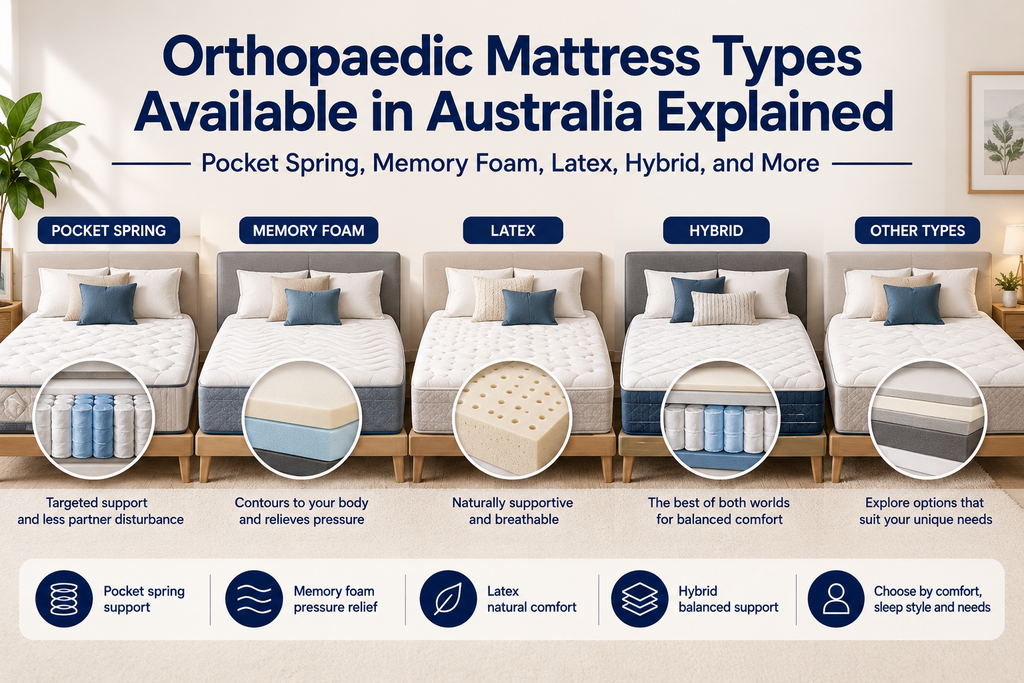
Orthopaedic mattresses can be constructed using several different support systems and materials. Here are five of the most common options.
1. Innerspring Orthopaedic Mattresses
Innerspring mattresses use metal springs or coils as their primary support system.
Common spring systems include:
- Bonnell springs: Interconnected hourglass-shaped coils offering traditional, firm support.
- Pocket springs: Individually wrapped springs that move more independently and respond to different areas of the body.
- Continuous coils: A connected wire system designed to create consistent support across the mattress.
For orthopaedic mattresses, spring systems are often selected because they provide responsive support and help prevent excessive sinking.
Pocket spring mattresses can be particularly useful because different sections of the spring system can be engineered to provide varying levels of support through the shoulders, hips and lower back.
Benefits:
- Responsive support
- Good airflow
- Familiar mattress feel
- Available in different firmness levels
- Strong support options for heavier sleepers
Considerations:
Traditional interconnected spring systems may transfer more movement between sleeping partners and can provide less targeted pressure relief than pocket spring systems.
Best suited to:
Back sleepers, stomach sleepers, people who prefer a traditional mattress feel and sleepers who prefer firmer support.
2. Memory Foam Orthopaedic Mattresses
Memory foam responds to body heat and pressure, allowing it to contour around the body.
Its main advantage is pressure relief. By distributing body weight over a larger surface area, memory foam can reduce concentrated pressure around areas such as the shoulders and hips.
This can make memory foam particularly appealing to side sleepers.
However, there are several factors to consider.
Heat retention:
Traditional memory foam can retain body heat. Modern mattresses may use open-cell or cooling technologies to improve airflow and temperature regulation.
Movement:
Dense memory foam creates a deeper contouring sensation, which some sleepers enjoy but others may find restrictive when changing sleeping positions.
Edge support:
Some all-foam mattresses provide less support around the perimeter compared with reinforced spring or hybrid mattresses.
Best suited to:
Side sleepers, people who prefer a contouring mattress feel and sleepers seeking additional pressure relief around the hips and shoulders.
3. Latex Orthopaedic Mattresses
Latex mattresses use natural, synthetic or blended latex as part of their comfort and support system.
Unlike memory foam, which tends to create a deeper cradling sensation, latex generally feels more buoyant and responsive.
Two common types of latex are:
- Dunlop latex: Typically denser and firmer.
- Talalay latex: Usually lighter and more responsive.
Latex can offer a useful balance between support and pressure relief while allowing sleepers to change positions relatively easily.
Natural latex is also popular with buyers looking for durable mattress materials.
Benefits:
- Responsive support
- Good pressure distribution
- Durable construction
- Less sinking than traditional memory foam
- Suitable for combination sleepers
Considerations:
Latex mattresses can be heavier and may cost more than many traditional spring or foam alternatives.
Best suited to:
Combination sleepers, people who prefer responsive support and buyers looking for a durable mattress.
4. Hybrid Orthopaedic Mattresses
Hybrid mattresses combine two or more mattress technologies, most commonly a pocket spring support system with foam or latex comfort layers.
This allows the mattress to combine the responsive support of springs with the pressure-relieving characteristics of foam.
The pocket spring system can provide:
- Structural support
- Responsive movement
- Improved airflow
- Edge stability
- Reduced movement transfer compared with traditional interconnected springs
The comfort layers can provide:
- Pressure relief
- Additional cushioning
- Body contouring
- Improved comfort around the shoulders and hips
For many sleepers, a hybrid orthopaedic mattress provides a practical balance between support, comfort and pressure relief.
Some hybrid mattresses also incorporate zoned support systems, allowing different areas of the mattress to respond differently to the body.
Best suited to:
A wide range of sleepers, couples with different comfort preferences and people looking for a balance between supportive springs and cushioned comfort layers.
5. Zoned-Support Orthopaedic Mattresses
Zoned support refers to mattresses designed with different levels of support across specific areas of the sleeping surface.
Rather than providing identical firmness from head to toe, a zoned mattress may provide additional support in areas that carry more body weight.
A typical system may include different support levels around the:
- Head and neck
- Shoulders
- Lower back
- Hips
- Legs
For example, the shoulder area may allow slightly more compression while the central section provides greater support around the lower back and hips.
Zoning is not necessarily a separate mattress material. It can be incorporated into:
- Pocket spring mattresses
- Hybrid mattresses
- Foam mattresses
- Latex mattresses
The objective is to provide a more balanced sleeping surface that adapts to different areas of the body.
Best suited to:
People seeking more targeted body support, combination sleepers and sleepers who prefer additional support through particular areas of the mattress.
Orthopaedic Mattress Types at a Glance
| Mattress Type | Support | Pressure Relief | Best Suited To |
|---|---|---|---|
| Innerspring | High | Low–Medium | Back and stomach sleepers |
| Memory Foam | Medium | High | Side sleepers and pressure relief |
| Latex | Medium–High | High | Combination sleepers |
| Hybrid | High | High | Most sleeping positions and couples |
| Zoned Support | Variable | High | Sleepers wanting targeted support |
There is no single mattress type that is automatically better than every other option.
The right choice depends on how the mattress distributes your weight, supports your preferred sleeping position and feels when you lie on it.
How to Choose the Right Orthopaedic Mattress
Before purchasing an orthopaedic mattress, consider the following factors.
1. Consider Your Sleeping Position
Your preferred sleeping position affects how your body interacts with the mattress.
Back sleepers generally need enough support to prevent excessive sinking through the midsection while maintaining comfortable contact with the mattress.
Side sleepers usually require greater pressure relief around the shoulders and hips.
Stomach sleepers often prefer a firmer surface that helps prevent the hips from sinking excessively.
Combination sleepers may benefit from a more responsive mattress that allows easier movement between sleeping positions.
2. Think About Support and Comfort Separately
A mattress does not necessarily need to feel extremely hard to provide good support.
The support system beneath the mattress helps maintain stability, while the comfort layers determine how the surface feels against your body.
A well-designed orthopaedic mattress should provide sufficient underlying support while still offering comfortable pressure relief.
3. Consider Your Body Weight
Mattress firmness feels different depending on the sleeper.
A mattress that feels firm to a lighter person may feel considerably softer to someone with a heavier body weight because they compress the mattress further.
This is why firmness labels such as “medium” or “firm” should be treated as a guide rather than an absolute measurement.
4. Look at the Mattress Construction
Rather than relying solely on marketing terminology, look at what is actually inside the mattress.
Consider features such as:
- Pocket springs
- Zoned support
- High-density foams
- Latex comfort layers
- Reinforced edges
- Comfort layer thickness
- Overall mattress depth
Understanding the construction will give you a clearer indication of how the mattress is designed to perform.
5. Choose the Right Firmness
Many people associate orthopaedic mattresses with extremely firm sleeping surfaces. However, firmer does not automatically mean better.
The ideal firmness should provide enough support without creating excessive pressure around areas such as the hips and shoulders.
For many sleepers, a medium-firm or firm mattress can provide a comfortable balance, but individual preferences vary considerably.
6. Consider Your Sleeping Partner
If you share your bed, motion transfer can become an important consideration.
Pocket spring, hybrid and foam mattresses can help reduce the amount of movement transferred from one side of the mattress to the other.
Edge support can also be important for couples because stronger edges increase the usable sleeping surface.
7. Check the Mattress Base Requirements
The base underneath your mattress contributes to its overall support and performance.
Depending on the mattress, manufacturers may recommend:
- Slatted bases
- Platform bases
- Ensemble bases
- Adjustable bases
Always check the manufacturer's recommendations, particularly if you are using an existing bed frame.
What Should You Look for When Buying an Orthopaedic Mattress?
When comparing orthopaedic mattresses, look beyond the product name and consider the actual features.
Support System
Understand whether the mattress uses pocket springs, traditional springs, foam, latex or a combination of materials.
Zoned Support
Look for additional support through areas such as the lower back and hips if targeted support is important to you.
Pressure Relief
Comfort layers should allow the shoulders, hips and other pressure-sensitive areas to settle comfortably into the mattress.
Edge Support
Reinforced edges can improve stability when sitting on the side of the bed and maximise the usable mattress surface.
Motion Isolation
For couples, look for a mattress that helps minimise movement across the bed.
Mattress Materials
Consider the quality, density and durability of the foams, springs, latex and fabrics used throughout the mattress.
Warranty
Check what the warranty covers, how long it lasts and whether there are specific requirements relating to your mattress base.
Frequently Asked Questions
What is the difference between an orthopaedic mattress and a normal mattress?
An orthopaedic mattress is generally designed with a greater emphasis on body support, spinal alignment and pressure distribution.
The actual difference depends on the mattress construction. Features such as stronger support systems, pocket springs, zoned support and high-density foams are commonly found in orthopaedic mattress designs.
Are orthopaedic mattresses always firm?
No.
Although many orthopaedic mattresses are medium-firm or firm, the right firmness varies depending on your body weight, sleeping position and personal comfort preferences.
Good support does not necessarily require the mattress to feel extremely hard.
What mattress type is best for back support?
There is no single mattress type that works for everyone.
Pocket spring, hybrid and zoned-support mattresses are popular options because they can combine structural support with pressure relief.
The right mattress ultimately depends on how your body responds to its firmness and construction.
Is memory foam suitable for an orthopaedic mattress?
Yes. Memory foam can be incorporated into an orthopaedic mattress, particularly as a comfort layer.
Its contouring properties can help distribute pressure around the shoulders and hips. It is also commonly combined with pocket springs in hybrid mattress designs.
Are hybrid mattresses good for orthopaedic support?
Hybrid mattresses can be a strong option because they combine a supportive spring system with foam or latex comfort layers.
This construction can provide responsive support while also delivering cushioning and pressure relief.
What firmness should I choose for an orthopaedic mattress?
There is no universal firmness that suits everyone.
Your body weight, preferred sleeping position and comfort preferences all influence how a mattress will feel. Rather than choosing the hardest available mattress, look for a firmness level that provides stable support while remaining comfortable.
How often should an orthopaedic mattress be replaced?
Mattress lifespan varies depending on its materials, construction, usage and maintenance.
Rather than relying solely on age, consider replacing your mattress if you notice significant sagging, loss of support, damaged materials or a noticeable decline in sleeping comfort.
Can an orthopaedic mattress help with back pain?
A supportive mattress may help improve sleeping comfort and reduce unnecessary pressure on the body, but a mattress should not be considered a treatment for back pain or a spinal condition.
If you experience persistent or severe back pain, seek advice from an appropriately qualified healthcare professional.
Find the Right Orthopaedic Mattress with Chiro Care Mattresses
Choosing an orthopaedic mattress is not simply about buying the firmest mattress available.
The right mattress should provide a combination of support, pressure relief and comfort that works with your body, sleeping position and personal preferences.
Innerspring mattresses provide responsive traditional support. Memory foam provides deeper contouring and pressure relief. Latex offers responsive cushioning and durability. Hybrid mattresses combine spring support with comfortable foam or latex layers, while zoned-support designs provide more targeted support across different areas of the body.
At Chiro Care Mattresses, our focus is helping Australians find orthopaedic mattresses suited to their individual sleep and support requirements.
Explore the Chiro Care Mattresses range or speak with our team to find an orthopaedic mattress that suits the way you sleep.